

The First Five Matter
Why Startup Success Starts with Early Hires (And The Empirical Data Supporting It)

Elite founders treat recruiting as a first-principles function, not an afterthought. The best early-stage teams move with speed, rigor, and intention. They compress cycles, stack interviews, debrief on the hour, and post-mortem obsessively. At Veridical Ventures were quantifying the founding team’s recruiting velocity and precision during due diligence - because in our opinion a startup’s ability to hire is the single most underpriced proxy for its ability to scale. We’re assembling the world’s largest dataset on early-stage founder recruiting capabilities, and we believe this dataset is predictive of venture-scale outcomes (and the Federal Reserve agrees).
Traction is ephemeral without talent. KPIs are meaningless without a team to sustain them. As a VC, imagine if you could identify the Google’s and Facebook’s that can recruit their Mayers and Sandbergs before it happens...
🧠 I spent most of my weekend nerding out on a 2023 Federal Reserve study on this exact topic and it blew my mind 🧠 . The report validates our thesis, and provides some of the clearest empirical evidence yet that the first employees at a company play a critical and lasting role in startup outcomes. The paper goes well beyond intuition and anecdotes. It offers causal evidence that early employees materially affect whether a startup grows, survives, and thrives long term.
Let’s dive in 👇
Rethinking the Founding Team
The startup world tends to lionize founders - and for good reason. But the founding team often includes a few more people than just the CEO and co-founders. The authors of the Federal Reserve study, “Early Joiners and Startup Performance” expand the lens to include those early joiners, the first few employees who come on board in the company’s first year.
Their premise is simple: just like a founder, these early team members shape product decisions, technical architecture, customer relationships, and company culture. They are carriers of “organizational capital” - a mix of tacit knowledge, shared norms, and team dynamics that can’t simply be backfilled if they leave.
And to make the data speak clearly, the researchers used an unusual but powerful methodology: they looked at what happened to startups when early team members or founders suddenly departed. This includes any unplanned separation, resignation, firing, or the employee simply exiting the startup scene altogether.
The result? When an early joiner leaves, the startup suffers a long-lasting hit to both headcount and revenue. And no, this effect doesn’t fade over time. It lingers for years.
The Case of Marissa Mayer
To ground this concept, the authors point to the story of Marissa Mayer, one of Google’s earliest hires. Though she wasn’t a founder, her fingerprints are all over Google’s early success. Mayer initially joined as a junior engineer but soon became the lead architect of the Google homepage. She played a key role in shaping not just the product, but the revenue model that underpins Google to this day.
She’s a perfect example of what the paper calls a high-impact early joiner: not a founder, but functionally irreplaceable.
High-Earning Early Joiners = Higher-Performing Startups
One of the most telling charts in the paper shows that startups with higher prior-earning founding teams - both founders and early joiners - grow faster, survive longer, and operate more productively.
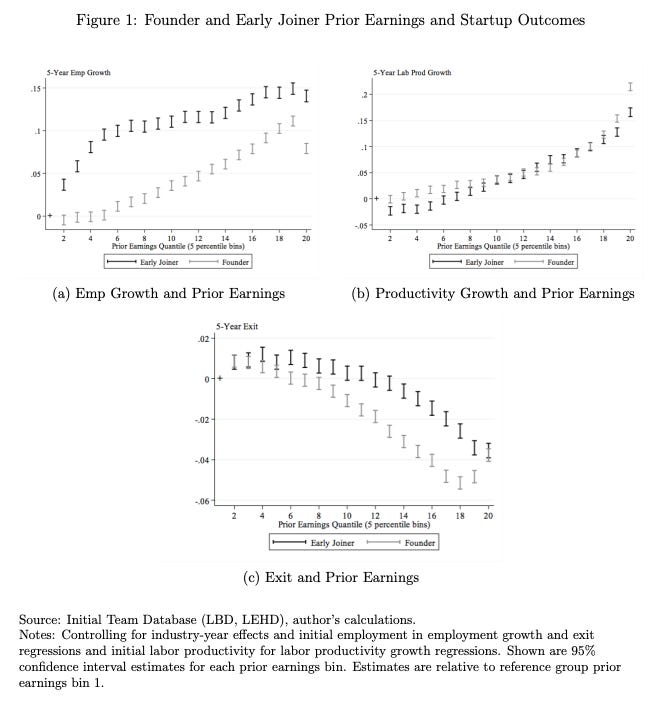
Startups where early team members came from high-paying prior jobs experienced faster employment and productivity growth.
They were also significantly less likely to exit the company in the first few years.
Translation: high-caliber early talent is a signal and a driver of startup quality. It’s not just the idea or market. The team matters, and not just at the founder level. Prior earnings are telling of both skill and resiliency.
Tenure Matters, Too
The report also surfaces something every operator intuitively knows: the longer great people stick around, the better the company does.
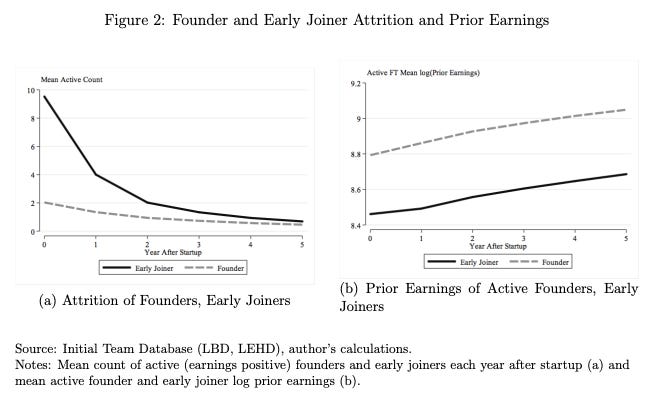
Early joiners leave at a higher rate than founders over time, but the ones who stay longer tended to have significantly higher prior earnings.
This suggests that retention isn’t just about loyalty, it’s also about quality. The best early employees tend to stay longer, and those who stay longer are more likely to help the startup succeed. Make sure these critical first hires, like your VC, are signing up for a decade long journey!
For B2B companies, the stakes are even higher. If your company sells into complex, enterprise workflows, the cost of losing an early joiner gets even worse.
The study found that B2B startups suffer disproportionately when early joiners leave. Why? Because in B2B, organizational capital - the nuanced knowledge of customers, processes, and delivery - is more specialized. The trust and insight those early team members carry simply doesn’t transfer easily.
Veridical’s Definition of Product Market Fit
The paper closes with an insight that aligns closely with our investment philosophy: great founders tend to recruit great early joiners. There’s a positive feedback loop between founder quality and early team quality.
Our industry fantasizes over this mystical, flashy, jargon of words we call product market fit. But what’s that really mean? We have no revenue threshold that a Company crosses where we hit the PMF gong. We have no KPIs or product engagement metrics that make us pop the PMF champagne. It’s simple: when a preseed/seed stage founder is able to convince the baddest engineers, most cutthroat GTM leaders, and visionary product folks to leave their comfy FAANG / Mag7 position, where they’re making high 6-figures to 7-figures per year, working twenty some hours a week, to jump ship and join this hopeful promise of a rocket vision - THAT’S product market fit. It’s a company’s rare mix of magnetic leadership, a compelling vision, strong hiring chops, and strong shared networks.
Regardless of the cause, the effect is clear. Great people attract other great people early on and that shapes everything that comes next.